
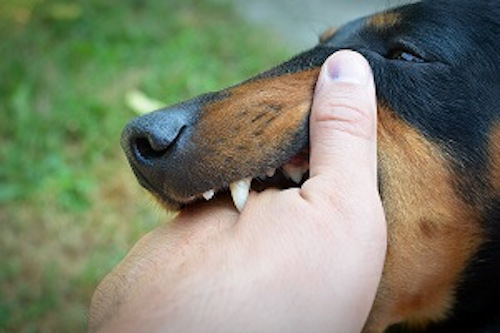
INFORMATION & FACTS ABOUT RABIES
- Rabies is a life threatning disease caused by a virus transmitted to human beings by bites from rabid animals. It can be prevented by timely local treatment of wounds, administration of rabies immunoglobulins (RIGs)/rabies monoclonal antibodies (RMAbs), and anti-rabies vaccines.
- An estimated 59,000 human rabies deaths occur every year. India alone reports an estimated 20,000 deaths per year and 17.4 million animal bites every year.
- Rabies is transmitted to humans largely by dogs and cats (>97%).
- Wild animals (2%) such as mongoose, foxes, jackals, wild dogs, wild rodents, and occasionally by monkeys, horses, donkeys, and others.
- Domestic rats, rabbits, and birds & Human bites are ordinarily not known to transmit rabies
VACCINATION STATUS OF THE BITING ANIMAL
Although unvaccinated animals are more likely to transmit rabies, vaccinated animals can also do so if the vaccination of the biting animal was ineffective for any reason. A history of rabies vaccination in an animal is not always a guarantee that the biting animal can not transmit rabies.
Animal vaccine failures may occur because of reasons like
- Not enough time elapsed since vaccination(< 3 weeks)
- Poor health status of the animal
- Incomplete course (schedule for dogs is – 1st dose at age 12 weeks, then 12 months & then a booster every 3 yrs) or missed boosters, etc.
- Vaccines used in animals are not 100% protective, so evn a fully vaccinated animal carries a 5-10% risk of getting the rabies.
Hence, post exposure prophylaxis should be given irrespective of vaccination status of the animal.
BITE BY ANIMALS OTHER THAN DOGS AND CATS
Bite by all wild animals should be treated as category III exposure. All animal bites in forest or in the wild should be treated as category III exposure.
VACCINATION NOT NEED IN THESE CASES
Bite by home rats, geese, squirrel, hare and rabbits and Human bites.
Pre-exposure prophylaxis (Pre-EP) is recommended in the following two situations.
• Children exposed to pets in home.
• Children identified to have a higher risk of being bitten by dogs. For practical reasons, any child who is now participating in any outdoor sport where a parent cannot be present should be considered a High Risk as there is lot of dog population in every society on every street.
WHAT TO DO AFTER AN ANIMAL BITE
- All animal bites should be washed for 10–15 minutes with copious amount of water and soap (detergent soap preferable)
- After allowing the wounds to dry for few minutes, antiseptics like povidone iodine and surgical spirit should be applied on all wounds to chemically inactivate or kill the rabies virus at the site of bite.
- Rabies risk is reduced to almost 50% by early and proper local treatment of wounds. Routine suturing of wounds and surgical dressing is not recommended.
Further Vaccine or Antibody administration is decided as per the category of the Bite and previous vaccination status of the patient
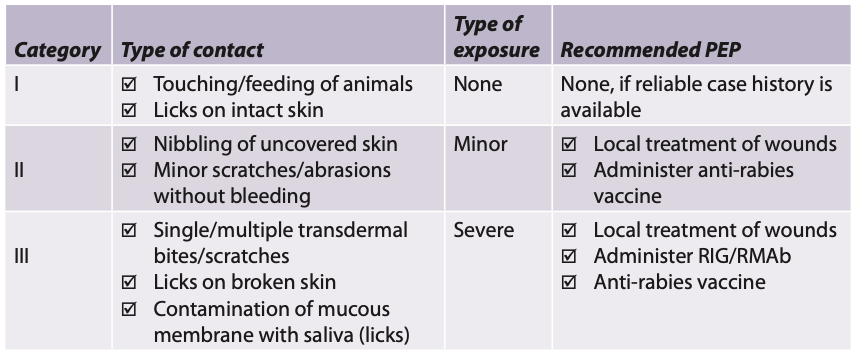
ANTI- RABIES SERUM(ARS)- Antibody or Immunoglobulin
All category III bites should be administered ARS as soon as possible, preferably in first 24 hours but not later than 7th day of the first vaccine dose
The WHO recommends that if available, the use of Rabies Monoclonal Antibodies(RMAb) should be preferred instead of Rabies Immuno Globulin (RIG)
ANTI-RABIES VACCINE (ARV) schedule by WHO(2022)
PRE- Exposure
On Days 0 and 7.
POST Exposure
A 4-dose schedule of either of the following-
- 1-site intramuscular administration of vaccine on Days 0, 3, 7 and between day 14-28 (Total doses=1+1+1+1=4) or
- 2-sites administration on days 0 and then on days 7, 21(Total doses=2+1+1=4)
In a rabies endemic country like India where there is sustained dog-to-dog transmission, every warm blooded animal bite is suspected as a potentially rabid animal bite. As rabies is practically 100% fatal, even bites to a previously vaccinated individual should be treated as a “Medical Emergency” and the post exposure prophylaxis must be provided immediately.
BOOSTER DOSES IN RE-EXPOSURE OF PREVIOUSLY VACCINATED INDIVIDUALS
- Re-Exposure within 3 months of completing a previous course of post exposure shots- No need of re-vaccination. Routine first aid care of wound should be done.
- Re-exposure beyond 3 months of receiving Anti rabies vaccine – give only two booster doses intramuscularly on days 0 and 3. Proper wound toilet should be done.
- Treatment with Rabies Immunolobulin (RIG)/Mono clonal Antibody is not required.
WHERE CAN WE GET ANTI RABIES TITERS DONE TO ACCESS THE EFFICACY OF THE VACCINES
Anti Rabies Titers can be done at National Centre For Disease Control, Shamnath Marg, Delhi – 110 054 on request.
NCDC (NICD)- 011-23909257 , 011-23913148, 011-23971272/060/344
 Dr Shacchee Baweja & Dr Vipul Baweja